Showing posts with label Film. Show all posts

Monday, 2 July 2012

King of the Ants (2003)


The King of Ants (2003) is a tough, bone-crunching crime thriller in which an odd-job man unwittingly falls in with a bad crowd that, with disturbingly little persuasion and a small sum money, he is assigned to spy and then murder an accountant. After carrying out the assignment but not receiving his fee and refusing to leave the country when told to do so, he is imprisoned by the gang. Then events get even more violent and twisted... I’ll leave it there with the plot, any more than that will do it a disservice.


Overall, The King of the Ants is a serviceable film with a brutal edge, and the harshness of that edge should come as no surprise to those accustomed with the films of Stuart Gordon. For the first 10 years of his filmmaking career (85-95) Gordon was known for his gruesome and blackly comic HP Lovecraft adaptations including Re-animator (1985), From Beyond (1986), Castle Freak (1995) and Dagon (2001). Since then he had a change of tack and brought his horror tropes to stories set in the real world, most notably Stuck (2007), which was based on a bloody true story. So, as in films like The King of Ants, Gordon brings an atypical abjectness to these dramas, and in this film in particular there are moments of horror and sadism where it really stands out. During the main protagonist’s imprisonment the gang ties him to a chair and wraps some foam around his head and proceed to repeatedly beat his head with golf clubs, their aim: to turn him into a vegetable. These scenes hurt. As a consequence the victim suffers from brief but horrific hallucinations involving transsexualism, chainsaws and a shit-eating creature that’s bizarrely a cross between a giant cactus and a woman; Gordon’s Lovecraftian past seeps in to sublime effect.

Another noteworthy feature is the film’s screenwriter: Charlie Higson, on whose debut novel the film is based. The reason this surprised me was down to the fact that, for me, Higson was synonymous with The Fast Show (94-01). I was aware he had become a successful children’s author but I did not know about his previous adult books. It was like finding out Johnny Ball had written Hostel (2005)! And if I knew about Higson's early novels and his perverse adult film Suite 16 (1994) then this revelation would have been even less of a surprise.

Thursday, 26 April 2012

The Ward (2010)

After dabbling in a spot of arson a disturbed young lady (Amber Heard) is admitted to a psychiatric hospital where she is subjected to Doctor Stringer’s pioneering therapies and accosted by an angry ghost that begins to kill her fellow ward-mates one by one.

Set in the late 60’s this workman-like horror achieves a good sense of time and place: the hospital has its obligatory haunted corridors and secret rooms, Jared Harris lends enough ambiguity to his role as the Doctor so we never know whether he is coolly mad or genuinely caring, but I never felt like the film added anything new to the genre. So it maybe a run of the mill horror that goes through its predictable machinations but the acting is sturdy and there are a few neat shocks; to be fair, it’s a perfectly good friday night chiller but what I found to be really at stake here is the reputation of its director, John Carpenter.

John Carpenter is responsible for creating classic pieces of cult genre cinema (Assault of Precinct 13, Halloween, The Fog, The Thing, Christine, Escape from New York, Big Trouble in Little China), and since those classics, which were made over 25 years ago, he succumbed to a series of flops (Memoirs of an Invisible Man, Ghosts of Mars, Escape from LA, Village of the Damned) which have left his fan base always eager to see if his latest work will rejuvenate or disappoint them. It’s a case of him not necessarily (re)creating a “Carpenter” film - especially when we have learnt that the likelihood of this happening is now so low - but more about containing enough  Carpenteresque moments to satisfy fans. The fans know Carpenter has the ability; surely his light will shine again, we hope, or maybe it will just be a faint glimmer, we will except.

This fall in standard is not unusual. For example look at Dario Argento (the less said about his input post The Stendhal Syndrome (1996) the better) and Francis Ford Coppola (after Rumble Fish (1983) what happened?). They had great periods, some spanned a handful of classic films, others more. Then the magic ran out. Maybe it’s not necessarily to do with talent being limited but more to do with a change in the way studios are run; restriction has dampened their flame.

So with The Ward, Carpenter did not create a new cult classic to add to his still impressive filmography, but the sad thing is that from a director who was so individual, this film could have been made by any horror hack.

Tuesday, 20 April 2010

Film: Some Thoughts on Mirrors & Movies

I love the horror genre and when I see a film that’s succeeded in frightening me - since it so rarely happens these days - I do a little celebratory dance.

Ok, I don't really do a dance but I do feel like I've found a little bit of treasure and feel the need to celebrate, as I did recently after watching Mirrors (2008). Not that I didn't see that coming because, as with haunted houses, evil children, bodily mutations and clowns, mirrors freak the hell out me out.

But, I wondered, why do mirrors freak me out?

I suppose it stems from being taught about a mirror’s cursed other worldliness from an early age; what other everyday household object can bring bad luck?

Aside from this pervasive superstition art, myths, literature and film also contribute to imbuing mirrors with a sinister side.

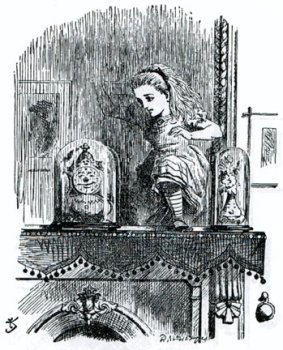
From Perseus’ mirrored shield fatally casting Medusa’s reflection back on herself, to the magical mirror in the Brothers Grimm's Little Snow-White (1812) and Lewis Carroll’s Alice Through the Looking Glass (1871) where the mirror acts a portal into another world (the imagination); mirrors transcend being just reflective to something altogether more powerful, holding infinite possibilities.

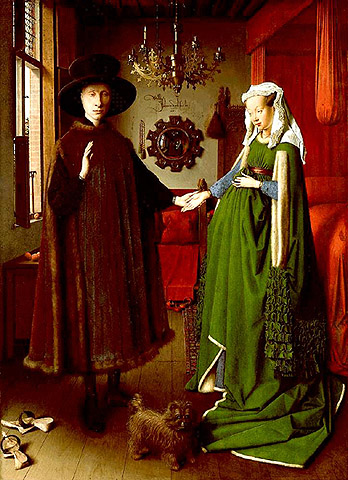
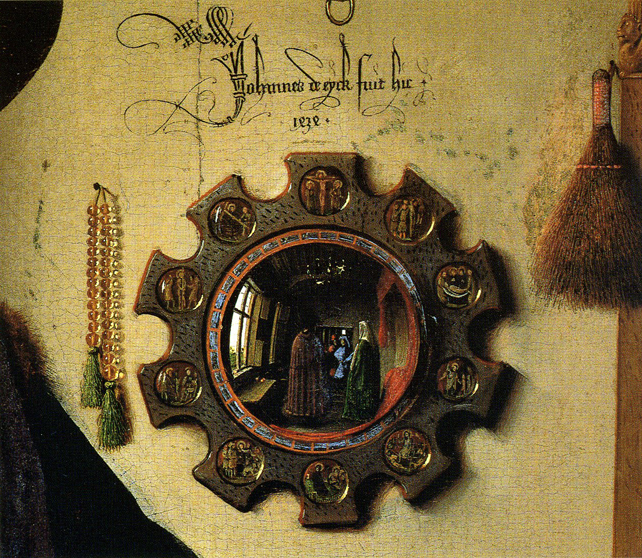
For some reason I’ve always found the convex mirror which lies in the background between the married couple in Jan Van Eyck’s Arnolfini Wedding Portrait (1434) eerie. Even though it reflects the two people in front of the couple (possibly the artist, or witnesses), when it's viewed from a normal distance the reflected people could be perceived to be the viewer, bringing the painting creepily to life.

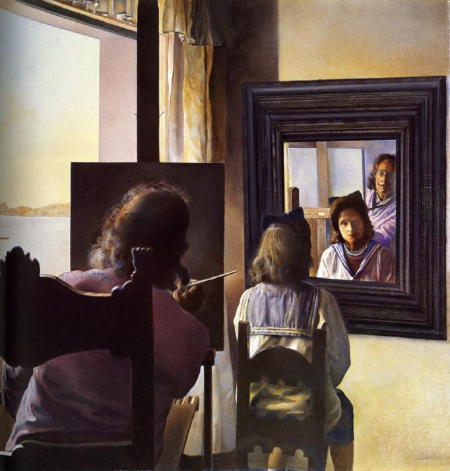
Surrealist painters M. C Escher and Salvador Dali have both painted themselves caught in a mirror’s reflection. And Escher painted a self-portrait in which he’s framed in a mirror, as if he’s standing behind the mirror, peering out at the viewer.

In films, mirrors are widely used to the point of becoming a cliché: how many times have you seen a protagonist looking into a shattered mirror to symbolise split personality; or the reflections of two people caught in two separate mirrors to symbolise distance in a relationship.

But it’s specifically in the horror genre that mirrors come into the fore, and where better to start than on another mirror cliché: the bathroom mirror shock-cut. You've probably seen it many times before but it still can work, playing on a knowing anticipation.

Mirrors can sometimes lead to other worlds, as in Carroll’s Alice. Jean Cocteau played with mirrors and in Blood of a Poet (1932) and Orphee (1950) they lead to a different dimension where simple camera trickery (reverse photography and slow motion) help . And with Evil Dead I & II (1981/87) Sam Rami followed suit with mirrors that have watery surfaces and get up to malevolent tricks - at one point nearly causing the lead protagonist to strangle himself.

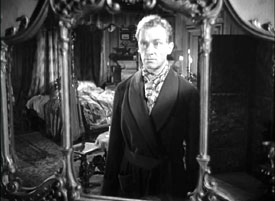
Malevolent mirrors are not unusual, capitalising on the power they have to lie and corrupt those that stand in front as in the portmanteau films Dead of Night (1945) and From Beyond the Grave (1973) where the mirrors cause their owners to, respectively, attempt suicide or commit murder in order to feed the mirror.

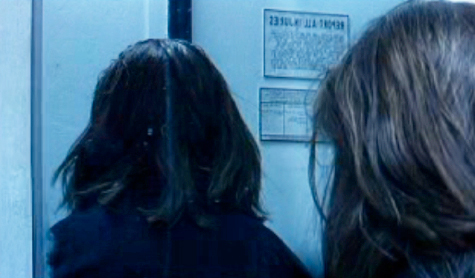
It’s scary when mirrors don't do their job and choose instead to lie like in Dolores Claiborne (1995) where a character looks at herself in a mirror only to confronted by her back; a conceit which may have been lifted from Rene Magritte’s Portrait of Edward James (1937).

Mirrors are also used as fetishistic objects as the Tooth Fairy killer in Manhunter (1986) does, putting shards of mirror in his victim’s eyes, or in Peeping Tom (1960) whose psychopath records his victims watching their own death distorting reflected in a mirror.

For me, the most audacious mirror scene in a horror film has to be in Deep Red (1975) where the killer can be spotted in a mirror 90 minutes before identity of the murderer is unveiled.

And finally, on a lighter note, my favourite mirror scene is the reflection dupe in Duck Soup (1933) where Groucho and Harpo battle it out, mimicking their increasingly bizarre routines to maintain the illusion of passing a mirror to great, classic, comedy effect.

Friday, 12 March 2010

Film: Films with Twists

WARNING!

This is a disclaimer to prevent being hypercritical.

This post is about films with twists and the importance of not knowing the existence of the twist. If you don’t won’t the twists of a handful of films spoilt, you are advised to ignore the post after paragraph 4.

Thank you.

I just wanted to make that clear, so-

Narrative twists and shock endings, when pulled off with finesse, are precious tools: they can make-or-break a film; they can make you want to re-watch a film; or deliver a satisfying feeling as the carpet is suddenly pulled from beneath you.

But should a film contain a twist or a shock ending, no matter how great it is and no matter how excited one is about sharing it, it must be kept a secret.

Knowledge of the twist must be treated like a good hand in a game of poker: keep it tight to your chest, bluff and keep schtum.

If the viewer knows there's a twist or a shock ending they'll try and figure it out and they might figure it out. Even if they don’t figure it out the film won't really take them by surprise because the ‘surprise twist’ has become an expected occurrence; more of a damp squib, especially if they've concocted half a dozen better endings which, after all, they've had the time to do.
Critics often set a bad example by using the phrase 'its got a killer twist', which is a good selling point and provides the potential viewer with a challenge, though much to the detriment of the twist's impetus.

Shockingly, in Mark Kermode’s Sight and Sound review of Ringu (1998) he revealed the film's denouement - one of cinema’s most frightening scenes - which was surprising considering how highly he thought of the film; so why give away such a pivotal moment in a review, Mr Kermode? (I was glad I read his review once I had seen the film.)

In terms of concealing a film's shock ending, I'd argue that the poster campaign for Neil La Bute’s The Wicker Man (2006) was far more effective than the 1973 original (though the same can’t be said for the film) by omitting the eponymous 'wicker man', therefore leaving what the title refers to to the viewer’s imagination, until the final reel.

The shock of the original The Wicker Man’s final moments remain effective but surely the final reel would have had its shock factor raised a few notches if the poster didn't give away what the eponymous wicker man was.

For me the best way to watch a film is to know as little about it as possible. The less I know about its plot, set-pieces, dialogue, even the milieu the better; I want the first viewing to be as fresh as possible.

This means avoiding previews. I find it best to stick to teaser trailers (if possible). Previews show too much, flaunting the film's best moments - although to be fair, previews are better than they used to be in that they run at such a break neck speed much of the action is subliminal, unlike earlier previews.
A good example of a teaser trailer that offers only the slightest flavour - but enough of a flavour for you to take the bait - is Christopher Nolan's Inception (2010), see it here.

Wednesday, 17 February 2010

Film: A Film Epiphany & The Freeze-Frame

A book has been released that set my mind wondering.

Screen Epiphanies by Geoffrey Macnab has 32 directors discussing 'the films which inspired them to pursue a career in the movie business, influenced their own film-making practice or stayed with them...' This got me thinking about my own 'screen epiphany'.

I remember the first film that had a significant impact on me. It was the first film I experienced that transcended mere joyous casual entertainment into something that made me realise how film could directly affect my emotions, and therefore reasserted film as a potentially powerful medium that demanded respect and caution. That film was Run Wild, Run Free (1969).

I don't think Run Wild, Run Free is well-known - it's not on DVD yet. I've only seen the film once - sometime during the mid-80's - so my memory of it is vague. I don't remember its plot but I do remember the emotional impact and physical response its ending had on me.

(Spoiler Alert!) The film ends with the main character, a young mute boy who works on a farm, being dragged out of a quagmire. At the moment he's released he makes a sound for the first time - a heartfelt wail if I remember right - then the the film freezes on his mud-splattered and distraught face. As soon as the freeze-frame happened I burst into tears. I remember how that reaction startled my young self.

I think the reason the film imbued this power over me was:

1) I identified with the main character, not only because he was played by Mark Lester who I'd already seen (and envied) in Oliver!(1968), he was also about my age (and we looked quite similar).

2) The film ended with no resolution. I suppose until then I had only seen conventional films with conventional family-friendly happy endings, so this was a shock.

3) That freeze-frame! The sheer power of its abruptness, arriving in the middle of action. The unexpected jolt of a sudden end was new to me; I wasn't ready for the final upsetting image nor the possibility of a freeze-frame.

... Seeing sadness frozen in time...

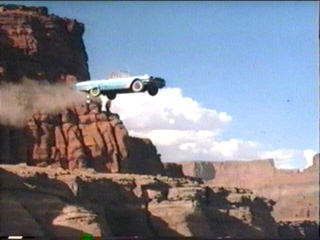
This recollection made me think about the use of freeze-frame endings in other films. Films such as Les Quatre Cent Coups (1959) (freeze then zoom into frozen image), Thelma and Louise (1991) and Gallipoli (1981) sprung to mind. In these films each freeze-frame occurs in the middle of action: capturing a fatal bullet wound (Gallipoli); the film's heroines(?) falling off the Grand Canyon, preserved in time moments before death (Thelma and Louise); and the hero coming to the end of a journey, finding freedom at the shore and looking directly at the audience (Les Quatre Cent Coups).

Each instance has an undeniably haunting and unforgettable quality, one which usually leaves the audience with an uncomfortable silence, partly due to momentary confusion (is the image stuck?), partly due to the emotional clout, like a journeying car's unannounced collision with a wall, a violent stop.

... A Sudden End.

This is a link to a Youtube clip which at 3.38 mark has an image of the freeze-frame from Run Wild Run Free .

Tuesday, 12 January 2010

Film: Some Irresistible Film Lists

Lists: some people hate them but I can’t get enough them, especially film lists.

I’ve been making film lists for years but it’s been ages since I compiled my favourite 100 films. I remember 8 ½ , 2001: A Space Odyssey, Wages of Fear, Badlands, Taxi Driver, Vertigo and Viranda made it into the top 10 circa 1997; I don’t know where they would be now and I don't know when I'll have the time to find out. Anyway, without further ado, let the listing - in no particular order - commence.

Best Films of 09

The Unloved (Samantha Morton)
This semi-autobiographical film about a child filtering from abusive father to the care system was my most heartbreaking experience of the year. It was first shown on CH4 but now has a well-deserved cinema release.
Let the Right One In (Tomas Alfredson)
The rarest of things: an original and successful horror film that's so much more!
Moon (Duncan Jones)
The best debut of the year that cements Sam Rockwell's reputation as one of the greatest yet underrated actors of his generation.
The Wrestler (Darren Aronofsky)
It's already a cliche to say this was the movie Mickey Rourke was born to be in, but it's so right. It's also great to see Aronofsky resuscitated after the disastrous The Fountain.
The Children (Tom Shankland)
A film on par with Rosemary's Baby and The Omen as a horror to prevent another baby boom.
Drag Me To Hell (Sam Rami)
Great to see Rami is back to doing what he does best: horror Evil Dead stylee!
Mesrine: Killer Instinct (Jean-Francois Richet)
Mesrine: Public Enemy No.1 (Jean-Francois Richet)
Vincent Cassel excels as Mesrine raising hell in France and Canada.
The Hurt Locker (Kathryn Bigelow)
Tension of the most unbearable kind has never been done so well so recently.
Slumdog Millionaire (Danny Boyle)
Story telling at its most exuberant.


Best Films I Saw In 09

Raise Ravens (Carlos Saura, 1976)
The Silent Partner (Daryl Duke, 1976)
4 Months 3 Weeks and 2 Days(Cristian Mugiu, 2007)
My Winnipeg (Guy Maddin, 2007)
You, the Living (Roy Andersson, 2007)
Edge of Heaven (Faith Akin, 2007)
The Mist (Frank Darabont, 2007)
I’ve Loved You So Long (Philippe Cludel, 2008)
Man on Wire (James Marsh, 2008)
Waltz With Bashir (Ari Folman, 2008)

Films Of 09 I Can’t Wait To See

Up
35 Shots of Rum
An Education
Fish Tank
A Serious Man
The Hide
Henri-Georges Cluzot’s Inferno
Inglurious Basterds
(funny how the adverts had to call it Inglurious but Stephen Fry's smooth talking Bar-Steward in the 90's Heineken Export adverts were green lit)
Johnny Mad Dog
Katalin Varga
Red Cliff
Rumba
Tony Manero
Timecrimes
The White Ribbon


Top 10 Films of the last decade (2000’s/Noughties)

The Diving Bell and the Butterfly (Julian Schnabel, 2007)
You, the Living (Roy Andersson, 2007)
Zodiac (David Fincher, 2007)
Once (John Carney, 2006)
Pan’s Labyrinth (Guillermo Del Toro, 2006)
Grizzly Man (Werner Herzog, 2005)
Head-On (Faith Akin, 2004)
Morven Caller (Lynne Ramsey, 2002)
City of God (Fernando Meirelles, 2002)
Jesus’ Son (Alison Maclean, 1999 – but released in 2000)

The Film Of 09 Which Most Felt Like A Shovel To The Head
(aka Bad Idea For A Date Movie
)

Previous winners of The Film Which Most Felt Like A Shovel To The Head were Funny Games (Haneke!), The Piano Teacher (Hanekeeeeee!), Wolf Creek, Flex and, for different reasons, a short film aptly named Dick.

Although Martyrs wasn't far behind, Antichrist wins this year. Lars Von Trier's film left me both exhilarated and numbed as it skated so closely to portentousness and preposterousness (eg, the slow motion showering of acorns over Dafoe - funny/weird) yet managed moments of sublime beauty and sheer horror; it's endlessly provocative and intriguing. For me it didn't match the emotional intensity of Breaking the Waves or the uncanny madness of The Kingdom but it did stay with me for weeks, much to my dismay. And thanks to Antichrist (and Insides is guilty of this, too) scissors will never be the same again.

Biggest Disappointment Of 2009

Previous winners have been Eyes Wide Shut and the films of Dario Argento 98 onwards (that's 5 films and counting).

The Curious Case of Benjamin Button wins hands down. After David Fincher's great run of films (particularly Fight Club and Zodiac) TCCOBB was such a let down. Overlong, not half as thought provoking as it thought it was and dull. If it had any redeemable features it was the special effects, in fact the whole movie is an excuse for the special effects. It is worth watching Brad Pitt as an old wrinkly baby, after which it's time to switch it off and put your copy on ebay.

Please don't do that to me again, Fincher...

Friday, 11 December 2009

Film: How to Enhance the Filmic Experience (without resorting to 3D)

Hypothetical Situation #1: I've won the Euro Lottery and built a specialist cinema.

Hypothetical Situation #2: You are in my specialist cinema.

So,

You're in my cinema and the film ends - the credits have arrived. But do not stand up; that's sacrilege. Instead, stay with the film. You're in my cinema and you must abide by my rules because I have a special surprise install for you, one that will enhance your overall viewing experience. So stay seated, calm and follow the instructions...

What happens next depends on what the film was. But one way or another, whether you are ushered through an alternative door or given a cryptic puzzle to solve, the filmic experience will transcend the silver screen and seep into your reality.

My reason for this is: I believe the filmic experience should not end as soon as the credits arrive; at this point the viewer is in a meditative, mildly hypnotic state. It takes a little while to adjust to reality after a film. How many times have you left the cinema and a felt little bit disorientated? Took a left turn instead of a right turn after leaving the cinema? Or been struck by the brightness of the outside world?

I want to exploit that state of mind by extending and externalising the filmic experience. For example, imagine the end of a screening of Don’t Look Now (1973), if it was compulsory to exit through another door that leads down a series of mock Venetian alleyways while a midget in a red raincoat darts hither and thither? Or imagine after a Saw movie the doors are shut, then Jigsaw comes up on the cinema screen and gives the audience a conundrum they have to solve before they can retrieve the key that will lead to their escape.

The closest I've heard anything coming close to this idea is theatre company Rumdrunk's It Felt Like a Kiss, where, the audience watches a 54 minute, hard hitting Adam Curtis documentary about the collapse of the American dream and terror spreading throughout the planet; after wich they are ushered through a series of eerie rooms and claustrophobic passageways.

If this can be done theatrically there is no reason why it can't be cinematically, too. With this is mind I'm off to Ladbrookes.

Oh, and Hypotheical Situation #3: Your mobile phone goes off in my specialist cinema.

Consequence: You will not see the phone in one piece again!

Film: 3D vs The Percepto

Cinemas around the country are adapting to 3D. But I think championing 3D is misguided (with the exception of animation films).

In the early 50’s there was a wave of 3D films in Hollywood then it fizzled out as quickly as it began. The same happened with the next wave, does anybody remember flocking to see Jaws 3D, Amityville 3D, Friday the 13th III 3D. More recently there’s been My Bloody Valentine 3D and The Final Destination 3D, not really a cause celebre.

As an alternative, filmmakers should resurrect horror movie maestro William Castle’s method of eliciting an immediate and physical response from his audience via an invention called the Percepto.

The Percepto was an electric buzzer that was wired to seats. At the appropriate moment in a film specially tailored for the Percepto (The Tingler (1958)), some of the audience received mild electric shocks.

Imagine doing the same to a modern audience, either tailoring a film for those exact effects, or create similar effects around existing films.

3D will fizzle out again, it's in its nature. As for the Percepto, its return is long overdue.

[This is an edited version. The unedited version can be found at http://andydwrightsfilmthoughts.blogspot.com/]

Thursday, 10 December 2009

Film: Our Mind's Movie Library

Sometimes we read a special passage that makes an instant, indelible imprint on our mind; the content sinks in and we remember it forever.

One such piece of writing for me is an article in Sight and Sound (Nov, 1993) in which the novelist, filmmaker and one-time film editor at Time Out, Chris Petit, ‘raids the movie library inside his head’.

The article is a stream of consciousness trail from one random movie memory to another. Whether or not I am familiar with the films, filmmakers, actors or theories he references does not lessen the impact of the piece; this is an enthralling meditation on movies and memory that reveals how we all contain reels of film stored in the archive that inhabits our mind, and with as little as a flick of a switch, we can project these magic moments once again.

Here is an extract from Petit's article:
‘… Clint Eastwood’s chipped tooth. Genevieve Bujold’s eyes. The tree-house in Swiss Family Robinson. The eaves of the attic room where Robert Mitchum kills Shelley Winters in Night of the Hunter. Bad early Jack Nicholson performances. Bresson’s note about the ejaculatory force of the eye. Jeanne Moreau’s shoes in Diary of a Chambermaid. The last walk in The Wild Bunch…’

There are about 200 of these memories and observations in the article. From the extract above, I could picture the tree-house, the eaves, the last walk, the shoes and some Roger Corman era poor Nicholson performances. But I had not seen Eastwood’s chipped tooth or Bujold’s eyes and sure enough, as soon as I watched Tightrope I was looking for that chipped tooth; and when I watched Dead Ringers I was entranced by Bujold’s glaring eyes.

For some reason though, there are two passages elsewhere in the article that always stuck with me: ‘the way Lee Marvin holds a gun’ and ‘the fact that films don’t say The End any more.’ These observations, both esoteric and astute respectively, reveal not only a lot about the author's passionate observation of film but also how film is a collective experience from which we each derive a very personal response: For Petit it is the eaves in The Night of the Hunter; for me it's Shelley Winters sitting in her car under the water, her hair flowing like reeds, I remember most vividly.

It's the power the image has to reach into us and remain inside us that fascinates me. Sometimes we cherish it like a close friend, sometimes we resent its intrusion, and during the course of a film, who knows when those moments may occur, or what they maybe.

And the question still stands: When did films stop saying The End (or Fin) and why?

[This is an edited version. The uncut version can be found at http://andydwrightsfilmthoughts.blogspot.com/]

Wednesday, 9 December 2009

Film: Fantastic Fabrications vs Real Reality

A few days ago I watched William Friedkin's Sorcerer (1977). One thing struck me most: it was a refreshing reminder of what witnessing a 'real' movie stunt feels like; a spectre that is seldom seen in modern cinema. This led me to conclude that the impressiveness of what can be achieved by the ingenuity of computers will never match the effectiveness of the ‘real’ stunt.

One particular moment in Sorcerer convinced me of the superiority of the 'real' over CGI's fantastic fabrications. In a tense scene lasting 8 minutes, filmed in a jungle during a violent tropical storm, a batch of huge trucks carrying nitro-glycerine drive over a weak wood-and-rope bridge that hangs precariously a foot or two above a raging, swollen river. Everything is real: real trucks, real bridge, real river and a real tropical storm.

What’s also impressive is, instead of stunt drivers and studio based close ups, the late Roy Scheider - among some other established actors - is driving one of the trucks. It's unbelievable. You just don't see that nowadays - unless you count Jackie Chan.

Now compare the truck-over-the-bridge scene in Sorcerer to a scene in X Men Origins: Wolverine (2009). The climactic fight scene revolves around three characters fighting on top of a colossal chimney that's in the process of collapsing. It is an impressive spectacle, no doubt, but CGI is by its very nature fake, so it maybe great to look at but it fails to reach the level of what it would have been like if Liev Schreiber, Hugh Jackman and the other guy were really on top of a collapsing chimney.

The problem is we know all too well from behind-the-scenes extras on DVDs that they were probably safely tucked up in studio at room temp, against a green screen with props and runners serving their every need. This makes it harder to suspend belief and easier to acknowledge that the reality of X Men is a lame shame compared to Sorcerer's 'real' relentless ambition.

My point basically is, if a film really wants to impress and awe an audience, bigger special effects won’t work as effectively as a real stunt. Such stunts were in films much more often a few decades ago, think about the Smokey and the Bandit (1977-83) and Cannonball Run (1981-89) trilogies for example. And when such stunts are done these days there's a fuss, as if it's something new. A recent example of this would be the hype that surrounded Quentin Tarantino’s Death Proof (2007). It was refreshing (and breathtaking) to see a dangerous stunt where a lady was crawling on a bonnet of a car travelling above the speed limit once again on the screen. Bravo!

[This is an edited version. The unedited version can be found at http://andydwrightsfilmthoughts.blogspot.com/]

[The bridge sequence can be found at http://www.youtube.com/watch?v=4y854SPM3C4]